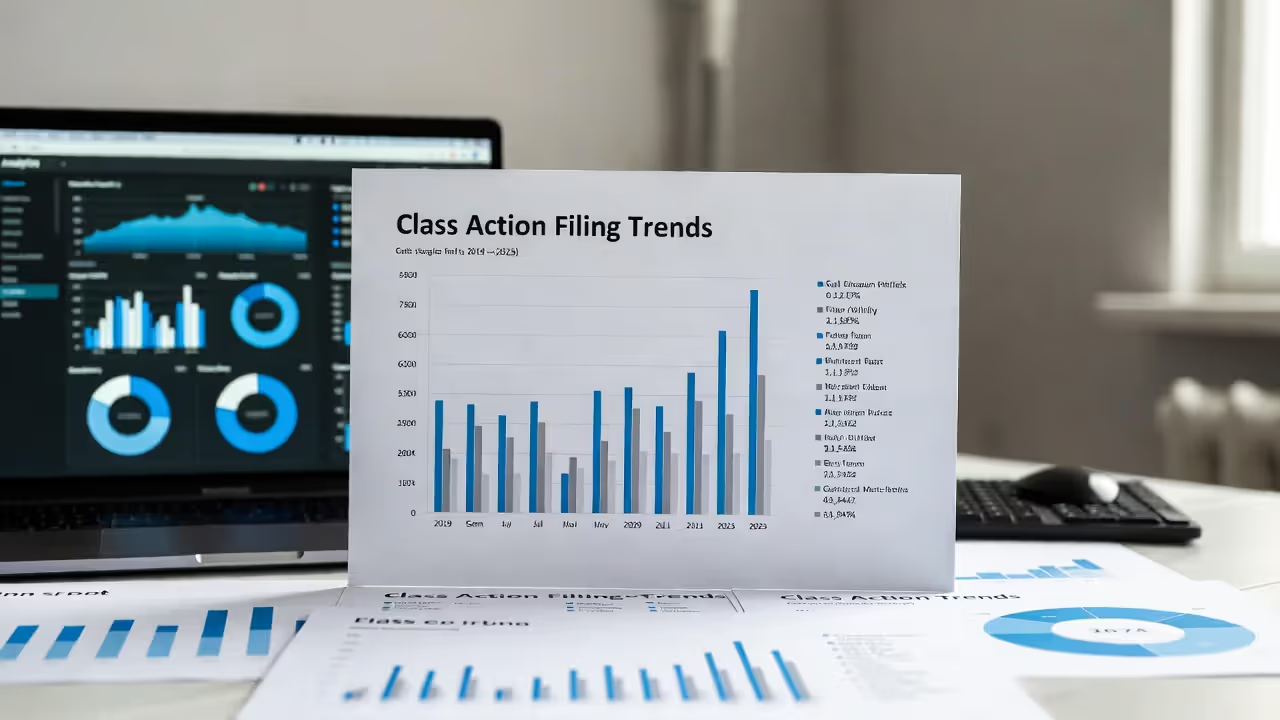
Here's what happened in 2023: federal courts processed 3,847 class action filings. That's down 12% from 2022, but still 28% above where things stood in 2019.
Why should you care? If you're running a business, these numbers show where your company might get sued next. If you're a consumer eyeing that settlement postcard on your counter, they explain why you'll probably receive less than the cost of lunch.
Data breach cases jumped 47% between 2022 and 2024. Securities fraud actions? Down nearly a third. Plaintiff attorneys chase the money—and right now, that means privacy violations and employment disputes, not stock drop litigation.
How Class Action Filings Have Changed Over the Past Five Years
Federal class action filings hit 2,998 in 2019. By 2022, that number peaked at 4,371 before dropping to 3,847 in 2023. But zoom out and you'll notice something: those cases didn't vanish. They moved.
California state courts handled 1,823 consumer class actions in 2023—up 19% from 2020. New York and Florida saw similar bumps. Plaintiff attorneys discovered that state courts offer better odds for certification, friendlier judges, and laws that actually favor consumers over corporations.
The Class Action Fairness Act was supposed to funnel more cases into federal court. It worked for a while. Then lawyers got creative. Illinois federal courts, which used to attract consumer cases from across the country, processed 487 fewer filings in 2023 compared to 2021. Those plaintiffs just refiled in state court instead.
Here's the pattern: cases involving state-specific consumer protection laws stay in state court to dodge Erie doctrine headaches. Data breach claims with federal hooks still land in federal forums. The Northern District of California processed 612 class actions in 2023—more than any other federal venue.
Defendants tried fighting back through removal. They yanked 73% of state-filed class actions into federal court in 2023. Judges sent 41% back within six months. That's six months of briefing, arguing, and billing hours—all for nothing.
Author: Andrew Whitaker;
Source: skeletonkeyorganizing.com
Which Industries Face the Most Class Action Lawsuits Right Now
Data privacy litigation owns 31% of all federal consumer class actions filed. You can thank high-profile breaches for that. T-Mobile got slapped with three separate nationwide class actions after exposing 37 million customer records in 2023. Total settlement tab: $350 million.
Employment cases grab second place at 24% of filings. Gig economy companies keep getting sued despite those arbitration clauses buried in their user agreements. California federal judge certified a class of 84,000 delivery drivers. The company argued that individual contract variations killed commonality. The judge disagreed.
Industry
Number of Cases Filed
Median Settlement
Primary Claim Types
Data Privacy/Cybersecurity
1,192
$18.5M
Breach notification failures, inadequate security
Employment
923
$7.2M
Wage theft, misclassification, discrimination
Consumer Products
687
$4.8M
False advertising, defective products
Securities/Financial
412
$23.7M
Disclosure violations, fiduciary breaches
Healthcare
298
$12.3M
Billing fraud, privacy violations
Consumer product cases focus on labels that lie. "Lightly sweetened" beverage litigation settled. Class members averaged $2.73 per claim. Attorneys collected $4.2 million. You do the math on whether justice was served.
Securities class actions dropped to 198 federal filings in 2023—the lowest count since 2016. The Private Securities Litigation Reform Act makes these cases tough to survive past dismissal motions. When they do settle, numbers get big: $23.7 million on average. But here's the catch: only 43% of securities cases filed between 2020 and 2023 resulted in any recovery for investors.
Healthcare litigation targets surprise billing now. A case attacked a hospital network for undisclosed "trauma activation fees" ranging from $1,500 to $8,000 on emergency room bills. The settlement created a $47 million fund. Claim rate? Barely 8%. Most patients had already paid and moved on with their lives.
Average Settlement Amounts and Payout Structures in Recent Cases
Securities cases average $23.7 million in settlements. Consumer cases settle for a median of $6.4 million. But those headline numbers hide the truth: 68% of consumer settlements go to attorney fees, claims administration, and incentive awards for named plaintiffs.
Take that $62 million data breach settlement from 2023. Only $8.4 million actually reached claimants because just 13.6% of eligible class members filed claims. The rest? It went to cy pres recipients—nonprofits that the parties picked instead of giving victims more money.
Why Most Class Members Receive Less Than $50
Author: Andrew Whitaker;
Source: skeletonkeyorganizing.com
Claims rates kill individual recoveries. Between 2020 and 2023, the median claims rate across all consumer class action settlements was 9.3%. Even massive settlement funds get diluted when participation stays low.
Three things tank claims rates:
Notice problems: Email and banner ads generate 4-7% response rates. Direct mail gets 18-22%, but costs $2-$4 per class member. That's money that could've gone to actual claims.
Complicated claim forms: Require proof of purchase? Expect claims rates below 3%. A study found that each additional field in an online claim form cuts completion rates by 11%.
Nobody bothers for $20: When potential recovery sits under $25, most people ignore it. Rational apathy wins unless the payout's substantial or filing takes under two minutes.
Mega-Settlements vs. Typical Case Outcomes
Equifax settled for $425 million after breaching data on 147 million people. Individual payments got capped at $125 for alternative compensation. Then 23 million people filed claims. Actual payout per person? Around $7.
Compare that to your typical consumer product case. A false advertising settlement over "all natural" claims created a $3.8 million fund. Subtract $1.4 million for attorney fees and $380,000 for administration. That left $2 million for 47,000 claimants—an average of $42.55 each.
Securities settlements work differently. Institutional investors actually file claims. Pension funds and mutual funds push claims rates to 60-70%, so settlement money reaches the victims. A $187 million securities settlement in 2023 paid out $179 million to claimants. The largest institutional investor received $23 million.
Class actions are less about individual compensation and more about aggregate leverage—where small harms become large exposure.
— John C. Coffee Jr., Columbia Law School
Emerging Legal Issues Driving New Class Action Filings
Illinois's Biometric Information Privacy Act turned fingerprint scans into gold mines for plaintiff attorneys. The law allows statutory damages of $1,000-$5,000 per violation. One fingerprint scan without proper consent triggers liability. Multiply that across thousands of employees or customers and you're looking at hundreds of millions in exposure. Facebook paid $650 million to settle an Illinois biometric case in 2021, which opened the floodgates.
AI discrimination claims represent uncharted territory. A class action alleges an employer's AI resume screener systematically rejected applicants over 45, violating the Age Discrimination in Employment Act. Proving algorithmic bias requires discovering training data and model parameters—technical challenges that courts are fumbling through right now.
TCPA cases keep coming despite reform attempts. Plaintiff firms use call tracking software to identify targets, then file cases seeking $500-$1,500 per call in statutory damages. Send 10,000 text messages without proper consent? Face potential liability exceeding $15 million. Recent cases target appointment reminders, shipping notifications, even two-factor authentication texts that consumers arguably requested.
Subscription trap litigation goes after companies that make cancellation painful. California's automatic renewal law requires clear cancellation mechanisms. A settlement over a "cancel anytime" subscription that required a phone call during business hours paid class members an average of $31 per claim.
Data broker practices face new scrutiny. Cases filed allege that collecting and selling consumer data without explicit consent violates state privacy laws and common-law privacy torts. These cases test whether decades-old legal doctrines can handle modern data practices. Spoiler: they probably can't without legislative help.
Author: Andrew Whitaker;
Source: skeletonkeyorganizing.com
How Federal Rule Changes Are Reshaping Mass Litigation Strategy
TransUnion v. Ramirez changed everything in 2023. The Supreme Court tightened Article III standing requirements—plaintiffs now need concrete harm, not just statutory violations. This hits data breach cases hardest, especially where damages are minimal or speculative.
Lower courts can't agree on what TransUnion means. Some require proof of actual misuse of compromised data. Others accept increased spam emails or targeted phishing as sufficient harm. Seventh Circuit decision dismissed a data breach case because the plaintiff couldn't show her exposed information was actually accessed or misused. The Ninth Circuit reached the opposite conclusion on similar facts. Circuit split, anyone?
Arbitration clauses with class action waivers stay enforceable after Epic Systems. But California's Private Attorneys General Act found a workaround. Individual employees can bring representative actions for labor code violations despite arbitration agreements. A PAGA case against a retail chain settled for $8.7 million, with 75% going to affected employees rather than attorney fees—unusually favorable.
Rule 23's ascertainability requirement splits circuits. The Third Circuit requires plaintiffs to show class members can be identified through reliable and administratively feasible methods. Other circuits apply looser standards. This matters for consumer cases where purchases weren't tracked or records disappeared.
Settlement approval got stricter after concerns about sweetheart deals and bloated attorney fees. Courts scrutinize cy pres awards more carefully now. A district court rejected a $12 million settlement because the proposed cy pres recipient was a scholarship fund at class counsel's alma mater. Too cozy.
State-by-State Differences in Consumer Class Action Activity
Author: Andrew Whitaker;
Source: skeletonkeyorganizing.com
California dominates consumer class actions—more than any other state. The Unfair Competition Law, False Advertising Law, and Consumer Legal Remedies Act provide multiple paths to class certification. Privacy statutes like CCPA create private rights of action for data breaches (though recent amendments limited statutory damages).
State
Total Filings (2023)
Most Common Case Type
Average Time to Resolution
Notable Laws
California
1,823
Data privacy, false advertising
2.7 years
CCPA, UCL, CLRA
New York
687
Consumer fraud, deceptive practices
3.1 years
GBL §§ 349, 350
Florida
512
Telemarketing, data breach
2.4 years
FDUTPA
Illinois
498
Biometric privacy, consumer fraud
2.9 years
BIPA, Consumer Fraud Act
New Jersey
341
Auto fraud, consumer protection
3.3 years
Consumer Fraud Act
Illinois's BIPA created a litigation cottage industry. The statute's private right of action, statutory damages, and plaintiff-friendly standing make it the most cited basis for biometric privacy claims. Defendants choose between expensive litigation and settlements often exceeding $20 million for mid-sized businesses.
New York's General Business Law sections 349 and 350 prohibit deceptive consumer practices. Courts interpret these provisions broadly. Unlike fraud claims requiring individualized reliance proof, Section 349 cases can proceed as class actions based on uniform misrepresentations. A case survived dismissal based on allegations that a retailer's "compare at" pricing used inflated reference prices that no competitor actually charged.
Florida's Deceptive and Unfair Trade Practices Act requires pre-suit notice and a cure opportunity, reducing frivolous filings without blocking legitimate cases. The statute's fee-shifting provision incentivizes plaintiff attorneys to pursue strong cases.
CAFA pushed many state-filed cases into federal court, but strategic plaintiffs still dodge it. Limit class size under 100 members. Keep amount in controversy below $5 million. Include in-state defendants that destroy complete diversity. Forum selection remains critical—it can determine whether you win or lose.
Frequently Asked Questions About Class Action Litigation Trends
What percentage of class action lawsuits actually go to trial?
Under 2%. Most cases end in dismissal (around 43%), settlement (about 51%), or voluntary withdrawal (roughly 4%). When trials happen, plaintiffs win approximately 38% of the time, but those verdicts face appeals and post-trial motions that drag on for years. Class action trials often cost over $5 million for complex cases, so even defendants with strong defenses prefer settlement.
How long does the average class action case take from filing to settlement?
Consumer class actions average 2.8 years from filing to final settlement approval, though this varies wildly by case type and venue. Securities cases average 3.6 years. TCPA cases often resolve within 18 months. The timeline breaks down roughly like this: motion practice (4-8 months), discovery (12-18 months), class certification briefing (6-9 months), settlement negotiations (3-6 months), court approval (4-6 months). Cases that survive class certification but don't settle can stretch to five years or longer.
Are class action filings increasing or decreasing?
Federal filings dropped 12% in 2023 and stayed relatively flat. But state court filings increased 8% during the same period. Cases are migrating from federal to state court rather than disappearing entirely. Data privacy and biometric cases keep growing. Securities and antitrust filings declined. Emerging issues like AI discrimination and subscription practices might drive increases in 2025.
Which states have the highest class action filing rates?
California leads with 1,823 state court consumer class action filings in 2023. New York follows with 687, then Florida (512), Illinois (498), and New Jersey (341). Measured per capita, Illinois and California have the highest filing rates. These states combine plaintiff-friendly substantive laws with procedural rules that make class certification easier. Delaware sees relatively few consumer class actions despite its corporate law prominence because most consumer transactions don't happen there.
How do companies typically respond to class action threats?
Most companies first try dismissing on pleading defects or moving to arbitration. If the case survives, defendants attack class certification by highlighting individualized issues that prevent common resolution. About 60% of class certification motions get denied or granted only in part. Companies also make early settlement offers to named plaintiffs to moot their claims before certification, though courts increasingly scrutinize these "pick-off" strategies. Insurance matters—most general liability policies exclude or limit class action coverage, making dedicated employment practices liability insurance or cyber liability policies essential.
What's the difference between settlement classes and litigation classes?
A litigation class gets certified for trial. Plaintiffs must satisfy Rule 23's requirements: numerosity, commonality, typicality, adequacy, and either predominance and superiority (for Rule 23(b)(3) classes) or cohesiveness (for Rule 23(b)(2) classes). A settlement class gets certified simultaneously with preliminary settlement approval. Courts apply a more lenient standard because there won't be a trial. Settlement classes can include members with weaker claims or more individualized issues because trial manageability isn't a concern. But courts still scrutinize settlement classes to ensure fairness and adequate representation of absent members' interests.
Mass litigation keeps evolving. Technology creates new legal theories. Procedural reforms reshape strategic calculations. Businesses face exposure from data practices that seemed routine five years ago. Consumers discover that joining class actions rarely provides meaningful compensation.
Expect more state court litigation. Biometric and AI-related claims will increase. Tension between class action procedures designed for traditional mass torts and modern consumer cases (where individual damages are minimal but aggregate exposure is substantial) will continue.
The current system works like this: plaintiff attorneys capture most economic value, businesses pay substantial settlements to avoid litigation costs, and class members receive modest compensation that rarely makes them whole. Does this arrangement deter wrongdoing and compensate victims? That's debated constantly.
What's certain: understanding litigation trend analysis helps businesses manage risk. It helps consumers set realistic expectations about potential recoveries from settlement trend reports. Don't expect a windfall from that data breach settlement. But do expect more cases in 2025.
Trademark strategy changed. The USPTO now demands transactional specimens and precise service descriptions, while examination waits lengthened and AI-copied language gets flagged. Courts raised the bar for trade dress proof, shifted confusion analysis (channels and sophistication), and expanded remedies for willful infringement. Expungement petitions surged, making use audits essential.
U.S. privacy litigation accelerated as BIPA biometric claims, CCPA/CPRA statutory damages, tracking-pixel and session replay suits, and dark-pattern enforcement expanded. Learn the most common causes of action, why class certification drives mega-settlements, which industries face the highest risk, and how companies adapt privacy programs to avoid lawsuits.
Federal environmental compliance shifted sharply in 2024: stricter PM2.5 standards, mandatory closed-cycle cooling for major intakes, expanded RCRA pharma waste coverage, tougher oil & gas methane monitoring, and broader TRI chemical reporting. Add stricter state rules and faster enforcement, and missed deadlines can trigger major penalties and shutdown risk.
U.S. cybersecurity regulation shifted fast: SEC 8-K incident disclosure within 4 business days, CISA’s 72-hour reporting proposals, tighter HIPAA timelines, and rapid state-law changes redefining “personal data.” Learn what triggers reporting, how deadlines differ by industry, and where enforcement penalties are rising.
The content on Legal Insights is provided for general informational purposes only. It is intended to offer insights, commentary, and analysis on legal topics and developments, and should not be considered legal advice or a substitute for professional consultation with a qualified attorney.
All information, articles, and materials presented on this website are for general informational purposes only. Laws and regulations may vary by jurisdiction and may change over time. The application of legal principles depends on specific facts and circumstances.
Legal Insights is not responsible for any errors or omissions in the content, or for any actions taken based on the information provided on this website. Users are encouraged to seek independent legal advice tailored to their individual situation before making any legal decisions.